
Author: Alisha De Matos
If you or someone on your team thinks AI project planning tools are still experimental add-ons, this blog post is for you. Lean in.
With tighter delivery cycles and increasingly complex cross-functional workflow, traditional spreadsheets and static Gantt charts simply can’t keep up any longer.
Here are 6 ways I’m using AI to streamline project planning with better deadline and resource management, while reducing operational risks (not to mention, saving the entire team’s sanity):
Teams Need Smarter Scheduling Through Predictive AI.
Smarter scheduling is one of the most immediate benefits of AI project planning tools. By analyzing historical data, task dependencies, and current progress signals, AI-driven project planning tools can forecast delays before they happen, allowing team leaders to take proactive steps to sidestep these operational roadblocks.
This moves the project management function from reactive to predictive.
Instead of revising timelines after milestones slip, teams can adjust in advance of the chaos.
AI project planning tools turn static project plans into living systems that continuously adapt as new information emerges. As part of a broader set of project planning resources, predictive scheduling reduces timeline variance and increases delivery reliability.
Faster Team Support Increases Workplace Satisfaction and Reduces Hidden Costs.
AI-powered project planning tools also elevate how you support your people. These tools analyze capacity, skills, relevant experience, and workload distribution to match tasks with team members like a perfect dating app, minus the awkward first dates. The end result is more sustainable allocations for your team, but the impact of this optimization goes far beyond convenience.
When work is misaligned, your valued employees face the frustration of preventable rework. In the best of situations, this requires costly and exhausting overtime. In worse case scenarios, this spin cycle pulls team members into burnout that can result in your greatest talent leaving the organization.
AI project planning tools help surface imbalances early, giving managers the chance to adjust before morale or performance declines. Used thoughtfully within your broader project planning resource stack, AI helps you protect both timelines and the humans responsible for delivering them.
Mitigate Risk with AI as Passenger #1 and Humans in the Driver’s Seat.
Risk mitigation is where AI project planning tools provide significant leverage. Spotting potential issues before they snowball? AI’s got your back. By scanning dependency chains, workload compression, and historical bottlenecks, AI surfaces early warning signals that might otherwise go unnoticed.
However, humans remain essential drivers and managers of AI.
AI detects patterns. Great, that’s critical. But where do we go from there? We need project managers to accurately interpret how those patterns sit inside the unique context of your business, product, competitive landscape, etc.
Organizational nuance, stakeholder dynamics, and strategic trade-offs still require human judgment.
The most effective teams use AI-powered project planning resources to enhance foresight, not to replace leadership. AI can highlight risk probability, but humans are still the best source to determine the right course of action based on those risk profiles. That machine-human partnership is what turns insight into intelligent execution.
Successfully Using AI to Arrive at Data-Driven Decisions Requires Clean Data Inputs.
Data-driven decisions are another strength of AI project planning tools. For those of us not in love with spreadsheets, being able to lean on an AI tool that crunches the numbers in a matter of seconds is an unmissable asset.
But effective AI depends on high-quality data. Inconsistent task tracking, incomplete documentation, or fragmented systems limit predictive accuracy.
Convinced You Have A Data-Driven Marketing Strategy? Why Most Brands Don’t
Many brands think they’re doing data-driven marketing but in truth, they’re not. So what is data-driven marketing, and how can you benefit from it? Come learn.
To maximize value from project planning tools, teams must standardize workflows and maintain reliable historical records.
Clean inputs enable stronger forecasting, better capacity modeling, and more accurate performance insights. In other words, AI project planning tools amplify operational discipline. The more structured your project planning resources, the more powerful your AI outputs become.
The Best Project Managers Reduce Cognitive Load—AI Lets Them Accomplish This Faster and More Efficiently.
Modern project planning resources are increasingly focusing on reducing cognitive load for the team members on a project, so they can each concentrate on their speciality skills and deliverables.
Top-tier project management is about way more than just tracking tasks.
AI-powered project management tools automate status updates, centralize information, and streamline communication, keeping your team in sync, automating busywork, and leaving more time for strategy and problem-solving.
And then there’s the cognitive advantages for the project manager, or the entire project management team in larger enterprises.
Project managers often struggle less with task volume and more with context switching, fragmented information, and decision fatigue. AI project planning tools reduce this cognitive drag by organizing signals into actionable insights. Instead of manually compiling updates or chasing down progress reports, leaders can focus on alignment, risk mitigation, and long-term planning.
That shift transforms project managers from coordinators into execution strategists.
Meeting Intelligence as a Planning Resource
Meeting recaps are another practical layer of AI project planning tools. Fathom is my go-to for recording meetings, taking notes, and generating detailed recaps. Missing a detail because of the post-lunch slump? Not anymore.
But AI meeting intelligence extends beyond summaries. It creates searchable institutional memory. Decisions, action items, and commitments become structured, retrievable knowledge.
As part of a broader ecosystem of project planning resources, AI meeting tools improve accountability and reduce repetition. Teams spend less time spinning around past decisions and more time moving initiatives forward with clarity.
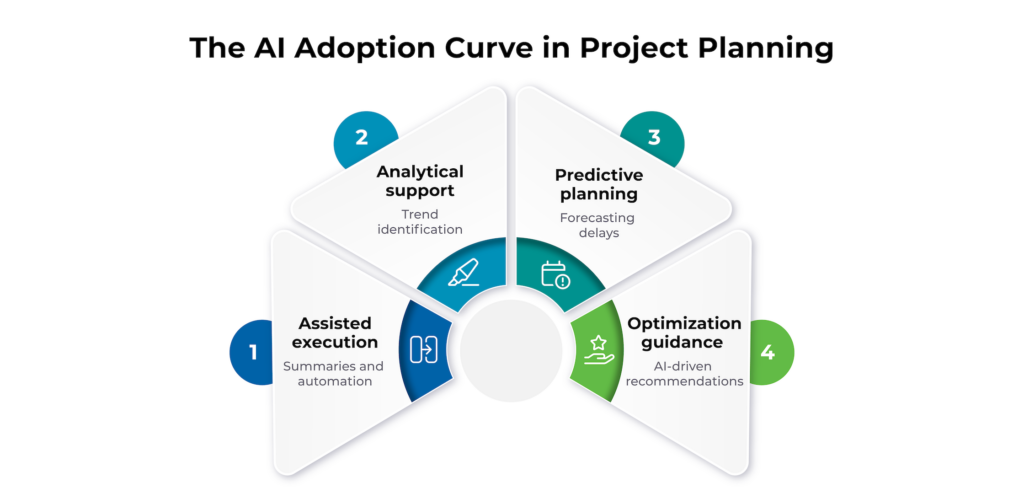
The AI Adoption Curve in Project Planning
Not every organization uses AI project planning tools at the same level. Most teams fall into one of four stages:
- Assisted execution (summaries and automation)
- Analytical support (trend identification)
- Predictive planning (forecasting delays)
- Optimization guidance (AI-driven recommendations).
At every stage, human oversight remains critical. AI does not set strategic priorities, negotiate stakeholder trade-offs, or navigate organizational politics. Project managers do.
The most effective teams treat AI-powered project planning resources as amplifiers of judgment, not replacements for it.
An Important Acknowledgement: AI Still Falls Short.
Even the most advanced project planning tools cannot resolve interpersonal conflict, influence diverse stakeholder groups, or build trust across remote teams.
AI excels at signal detection and pattern recognition, but context, persuasion, and leadership remain human strengths.
When teams utilize AI project planning tools with clear boundaries around the roles and responsibilities for humans vs the AI in question, AI helps to reduce complexity and improve foresight.
However, when used blindly, it risks over-automation without understanding.
In Conclusion…
AI project planning tools are here to make project success more intelligent, not to replace project managers.
As organizations adopt modern project planning resources, the competitive advantage will belong to teams that combine predictive technology with disciplined processes and empathetic human leadership.